What To Do When Storm Damage Breaks a Tree Near Your Home
Storm snapped the top off a cedar or pine near your house? Learn how we assess safety risks and when to remove, repair, or monitor a damaged tree.
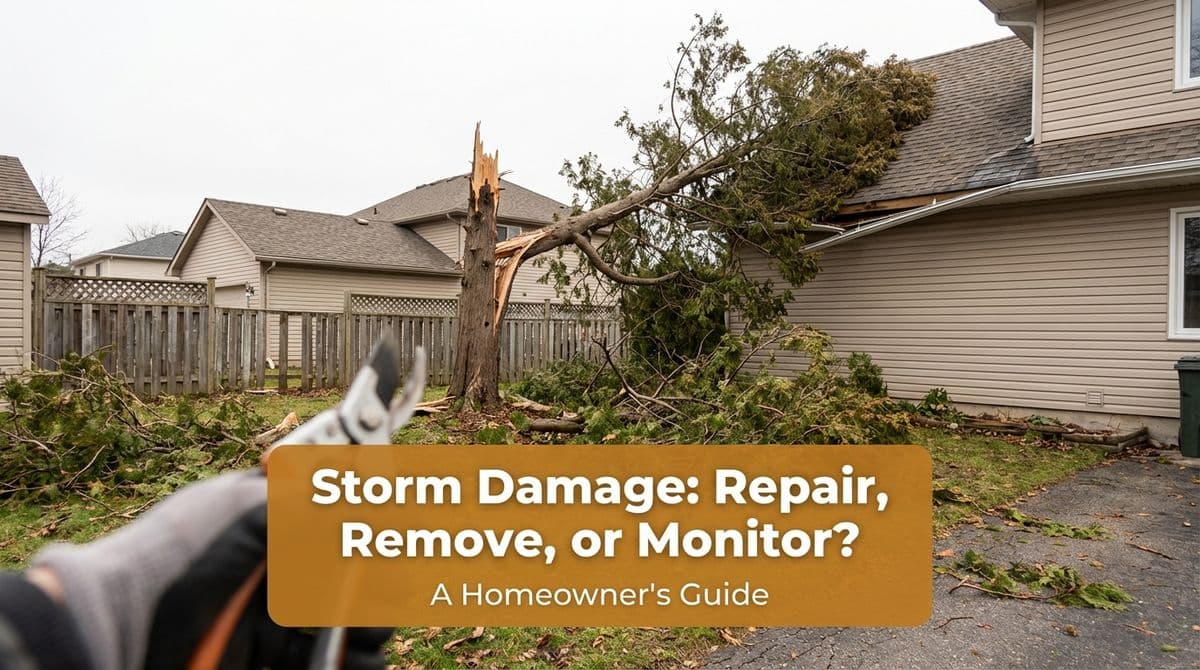
When a Storm Knocks the Top Out of a Tree Near Your Home
We recently got a call from a homeowner — let’s call him Tom — who had just been through a nasty windstorm. Tom told us, “The tops are knocked out of a cedar and a pine, and they’re close to the house. We know people who can take the trees down, but we’re wondering if we should save them instead.”
That kind of call is very familiar to us. After big storms, we hear from a lot of folks with “topped” or broken-crown evergreens (cedars, pines, and spruces especially) right next to their homes. The big questions are always the same: Is the tree safe? Can it be saved? Or is removal the smartest move?
In this guide, we’ll walk you through how we think about those decisions on every storm-damaged tree we inspect, so you can have a clearer sense of your options before we even step onto your property.
Step One: Make Sure the Area Is Safe
Before anyone gets too close to a damaged tree, we always talk about safety. A tree with its top broken out can look stable but still be ready to shed more wood without much warning.
Here are the things we recommend homeowners do right away after storm damage:
- Stay clear of the “fall zone.” If the tree or the broken section could hit the house, driveway, deck, or play area, keep people and pets out of that zone until it’s checked.
- Look for hanging or “widowmaker” limbs. If you see broken branches or chunks of trunk hung up in the canopy, don’t walk or park under them.
- Check for utility involvement. If any branches or the trunk are touching power lines, call the utility first. We won’t touch a tree that’s energized.
- Don’t cut it yourself from a ladder. Broken tops are some of the most dangerous DIY cuts. The wood is twisted and unpredictable, and it can kick back hard.
Once the immediate hazard is controlled, we can step in and start the real evaluation.
How We Evaluate a Storm‑Damaged Evergreen
When we met Tom at his property, our first goal was to give him all the information he needed to make a decision — whether he chose to hire us, another company, or even handle some minor work on his own. That’s the same approach we bring to every site visit.
With a cedar or pine that’s lost its top, we walk through a few key questions:
1. How much of the crown is gone?
If just a small leader or upper limb snapped, the tree often has a good chance of recovery. But if more than about 25–30% of the live crown is gone in one event, stress and decay risks go way up.
With true tops knocked off, we ask:
- Is the break clean or did it shatter the trunk?
- Is there a single clear leader left that can become the new top?
- Is the remaining crown balanced, or badly one‑sided?
2. How close is the tree to the house or target?
A compromised tree out in the back forty is one thing. The same tree 15 feet from a bedroom or over a driveway is very different. We look at:
- Distance to structures: How far is the trunk and how far could any failing part reach?
- Direction of lean: Is it leaning toward the house or away from it?
- Soil and root conditions: Any heaving, cracking, or soggy ground around the base?
Sometimes the damage itself isn’t catastrophic, but the risk is high simply because of where the tree is standing.
3. What’s the tree’s overall health and species?
Certain evergreens are better candidates for “saving” after losing a top. For example:
- Cedars: Often tolerate reduction a bit better, and can sometimes be reshaped, though they may always look a little odd.
- Pines: Tend to have a strong central leader and don’t usually respond gracefully to losing it. They may send out multiple weak tops that are prone to future breakage.
- Spruces and firs: Somewhere in between; some can be trained to a new leader, others decline over time.
We also look for pre‑existing issues like decay at old branch stubs, insect damage, or fungal fruiting bodies. A storm‑broken top on an already weak tree is usually a sign to consider removal.
When Removal Is the Smartest Choice
No one likes to take down a mature tree, especially if it’s been there for decades. But there are situations where we’ll almost always recommend removal, particularly near a house:
- Major structural loss: More than a third of the live crown is gone, or the trunk is badly split or twisted.
- Severe lean toward the home: Especially if that lean is recent or worsened after the storm.
- Compromised base or roots: Soil heaving, cracked roots, or visible decay at the base.
- High target value: If failure would likely hit a bedroom, main living area, or heavily used driveway.
In Tom’s case, if either the cedar or the pine had shown deep splits below the break, or a fresh lean toward the roof, we would have steered him toward removal before anything else.
When Pruning or “Repair” Can Work
Sometimes a broken‑top tree can be made reasonably safe and allowed to keep growing, especially if it’s in a lower‑risk location. What we might recommend:
- Crown clean‑up: Removing jagged stubs and hanging branches to reduce the chance of additional breakage and decay.
- Training a new leader: On some evergreens, we can select a strong upper branch, stake or cable it upright, and let it become the new top over time.
- Selective reduction: Shortening some upper limbs to reduce leverage and rebalance the crown.
We’re always honest that a “repaired” evergreen that lost its top will probably never look exactly the same again. The questions we ask with you are: Is it reasonably safe? Does it still provide shade, screening, or sentimental value? Are you okay with a more irregular shape?
When Cabling or Monitoring Makes Sense
For some borderline cases where you don’t want to lose the tree but removal feels premature, we sometimes suggest support systems and regular monitoring:
- Dynamic cabling: Flexible cables installed between major stems to reduce the risk of splitting in future storms.
- Bracing rods: Steel rods through a cracked crotch or union to hold it together.
- Annual or biannual inspections: We keep an eye on wound closure, decay development, and new growth patterns.
Cabling is not a guarantee that a tree will never fail, but it can buy years of safe, useful life for a tree you’re not ready to remove — especially if it’s just near, not directly over, your home.
How to Decide: Remove, Repair, or Monitor?
When we walk a property with a homeowner after a storm, we usually lay out all three options and talk through:
- Safety risks to people and property
- Tree health and expected lifespan after damage
- Budget and timing
- What the tree means to you (shade, privacy, memories)
With Tom, our promise was the same one we make to everyone: we’ll show you what we see, explain your options in plain language, and help you choose what makes sense — whether that ends up being full removal, careful pruning and cabling, or simply keeping a close eye on the tree over the next few years.
If a storm has broken the top out of a cedar, pine, or other evergreen near your home, the best next step is a professional eyes‑on evaluation. From there, we can help you decide whether to remove, repair, or monitor so you can feel confident that the tree above your home is as safe and sound as possible.