Pine Trees Dripping Sap? When to Prune or Remove
Pine trees dripping sap on your driveway or walkway? Learn when pruning helps, when removal is smarter, and what you can do about sticky pitch in the meantime.
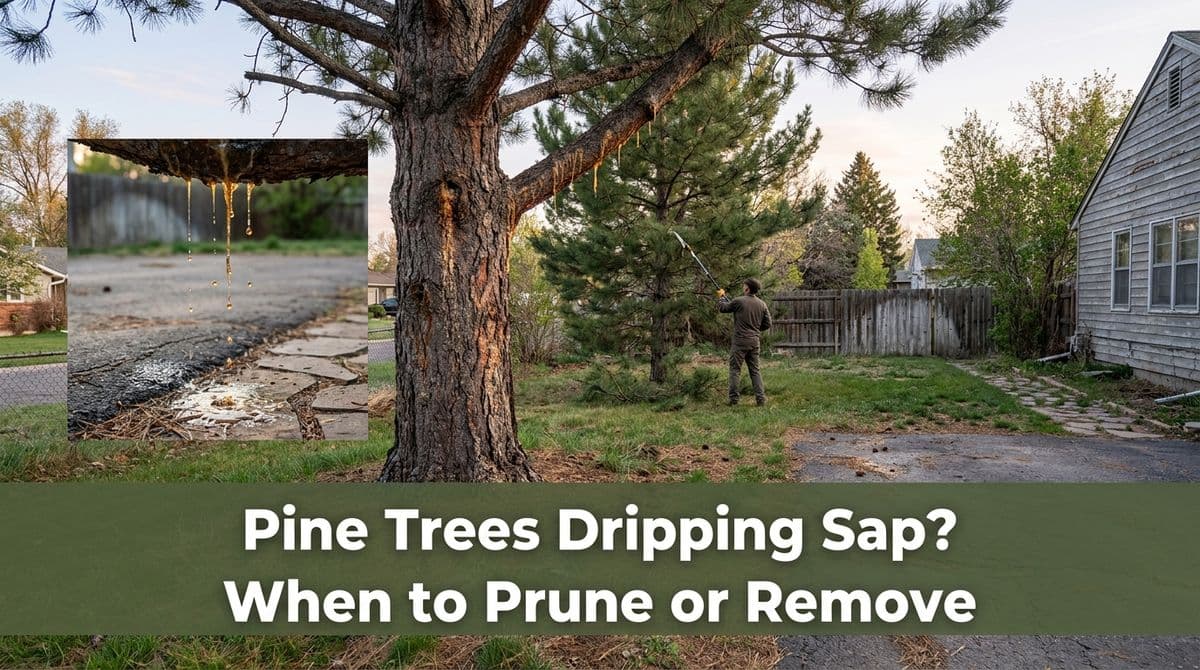
When Pine Trees Start Dripping Sap on Everything
We recently got a call from a homeowner — let’s call him Tom — who was pretty frustrated with the pine trees around his driveway and front walk. Every time he parked his cars, they ended up covered in sticky pitch. The sidewalk to his front door was dotted with sap spots that tracked onto shoes and into the house.
Tom told us he had one pine right by the driveway that he wanted completely removed, plus several others in the front and back that had never been pruned in the 12 years he’d owned the home. Two of those front trees were dripping sap right onto the walkway, and he wasn’t sure if pruning them higher would solve the problem or if they needed to come out entirely.
That’s a question we hear often: “If my pine tree is dropping sap on my driveway or sidewalk, should we prune it or remove it?” So we thought we’d walk you through the same advice we shared with Tom, step by step.
Why Pine Trees Drip Sap on Driveways and Walkways
Pine sap (often called pitch) is part of a tree’s natural defense system. A certain amount of sap is normal, but when it’s all over your cars, concrete, and shoes, it becomes more than just a minor annoyance.
We usually look at a few main causes when we see heavy sap drip:
- Heat and sun exposure: Hot weather and direct sun can make sap flow more freely, especially on the south and west sides of a tree.
- Stress or damage: Storm damage, poor pruning cuts, lawn equipment nicks, or construction near the roots can all cause a tree to bleed more sap.
- Insects and disease: Borers, bark beetles, and some fungal issues can trigger heavy sap flow as the tree tries to seal off the damage.
- Natural growth habit: Some pines simply produce more sap than others, especially when lower limbs extend right over hard surfaces.
In Tom’s case, the pine over the driveway had broad, low limbs that spread right over the parking area. The front trees by the walkway had uniform limb lengths — you could tell someone had trimmed them at some point — but the branches still hung over the path just enough to drip pitch where people walked.
When Pruning Can Help (and When It Can’t)
Before jumping to removal, we always look at what careful pruning can do. With pines, limbing up (removing lower branches) and thinning (selectively removing inner branches) can sometimes move the drip zone away from driveways and walks.
Pruning is often a good option when:
- The tree is generally healthy and structurally sound.
- The branches causing the problem are lower limbs directly over the driveway or walkway.
- You value the tree for shade, privacy, or curb appeal.
- There’s enough height to safely raise the canopy without butchering the tree.
With Tom’s front pines, we could see that trimming them up might get the sap off the walkway — but it was right on the edge. The branch structure was very uniform, and we didn’t want to over-prune and stress the trees. Because he didn’t rely on those particular trees for shade, we told him we’d evaluate them on site and be honest about whether pruning alone would really solve the issue.
When It’s Time to Remove a Pine Tree
Removal is a bigger decision, but sometimes it’s the most practical long-term solution. We usually recommend removal when:
- The tree constantly drips sap on high-use areas (driveways, walkways, patios) and pruning won’t move the drip line.
- The tree is structurally compromised or has significant insect or disease issues.
- Roots are impacting foundations, driveways, or sidewalks.
- You’re not getting much shade or benefit from that particular tree.
That was the situation with Tom’s driveway pine. The limbs extended right over where he parked every day, and even a fairly aggressive pruning would still leave sap falling on the cars and concrete. Since the tree wasn’t providing critical shade and had already become a constant maintenance headache, we agreed that full removal made the most sense.
What Homeowners Can Do About Sap Right Now
Even before we come out to look at your trees, there are a few simple steps you can take if pine sap is driving you crazy:
- Document the problem: Take clear photos of the tree, where you park or walk, and the sap on cars or concrete. This helps us give you a ballpark estimate from pictures, like we did before we headed out to Tom’s place.
- Check for patterns: Notice which branches are directly above the worst sap spots. Sometimes that makes it clear whether limbing up could help.
- Try temporary protection: If you can’t move where you park, consider a car cover or repositioning vehicles slightly away from the heaviest drip zones.
- Clean sap carefully: On cars, use products specifically designed to remove tree sap, and always test a small area first. On concrete, a degreaser and a stiff brush can help, but really stubborn stains may never disappear completely.
These won’t fix the underlying issue, but they can buy you some time until we can assess whether pruning or removal is best.
How We Decide: Prune vs. Remove
When we come out to your property, we walk through a similar process to what we discussed with Tom over the phone:
- Look at the whole picture: How many trees are involved? How close are they to the house, driveway, and walkways?
- Evaluate tree health: Are we seeing dieback, insect activity, or visible stress, or is the tree otherwise healthy?
- Identify your priorities: Do you rely on those trees for shade or privacy, or are they mostly decorative?
- Map the drip zone: We look straight up from where the sap is landing to see which branches are responsible.
- Recommend a plan: Sometimes that’s limbing up and thinning several trees, sometimes it’s removing just the worst offender, and often it’s a mix of both.
With Tom, we gave a ballpark number based on what we could see from mapping and then refined it on site once we’d inspected all six trees. We approach every yard the same way: balance your budget, your frustration level with sap, and the long-term health and safety of your trees.
Not Sure What to Do About Your Pine Trees?
If you’ve got pine trees dripping pitch on your driveway, sidewalk, or patio, you don’t have to guess whether pruning or removal is the right move. Send us a few photos so we can give you a ballpark over the phone, and then we’ll come out, walk your property with you, and put together a plan that keeps your trees — and your concrete and cars — in the best shape possible.