Is My Backyard Tree Dangerous? Prune or Remove It?
Worried your backyard tree might be dangerous? Learn how to spot decay, insect damage, and safety risks so you can decide between pruning and full removal.
Is My Backyard Tree Dangerous? A Real Elm Tree Story
We recently got a call from a homeowner — let's call him Adam — who had just bought a house and was worried about a big elm tree in his backyard.
The tree was about 40+ feet tall, looked green and fairly healthy from a distance, but after a recent windstorm a large branch snapped off and landed perfectly along the fence line between him and his neighbor. No damage that time — just a very lucky break. When Adam cut up the fallen limb, he noticed the wood didn’t look right and there were ants crawling in and out of the rotten sections.
Another company had already told him, “It looks green, but it’s old, has water damage, and probably won’t recover. You should just take it out.” The quote felt high to him, so he called us wanting a second opinion: “Do I really need to remove this tree, or can I just prune it?”
That question comes up a lot, especially with older backyard trees near homes, fences, and roofs. Here’s how we walk homeowners through that decision.
First Question: Is This Tree a Safety Risk?
When we look at a tree like Adam’s elm, the first thing we assess is risk. A 40+ foot tree close to a house, fence, or power lines is not something you want failing in a windstorm.
Here are the main red flags we look for during a safety check:
- Past failures: Has the tree already dropped big limbs, like Adam’s did during that windstorm?
- Target zone: If something falls, what’s underneath? House, roof, fence, garage, playset, patio, or neighbor’s property?
- Leaning or shifting: Is the tree leaning more than it used to, or is the soil heaving or cracking near the base?
- Entry points for decay: Old pruning cuts, storm damage, or trunk wounds where water can sit and rot can start.
If a tree is tall, close to structures, and has already started dropping heavy limbs, we treat that as a significant warning sign. The fact that Adam’s branch “barely missed” damage didn’t reassure us — it told us the tree had already started to fail.
Signs of Decay Inside the Tree
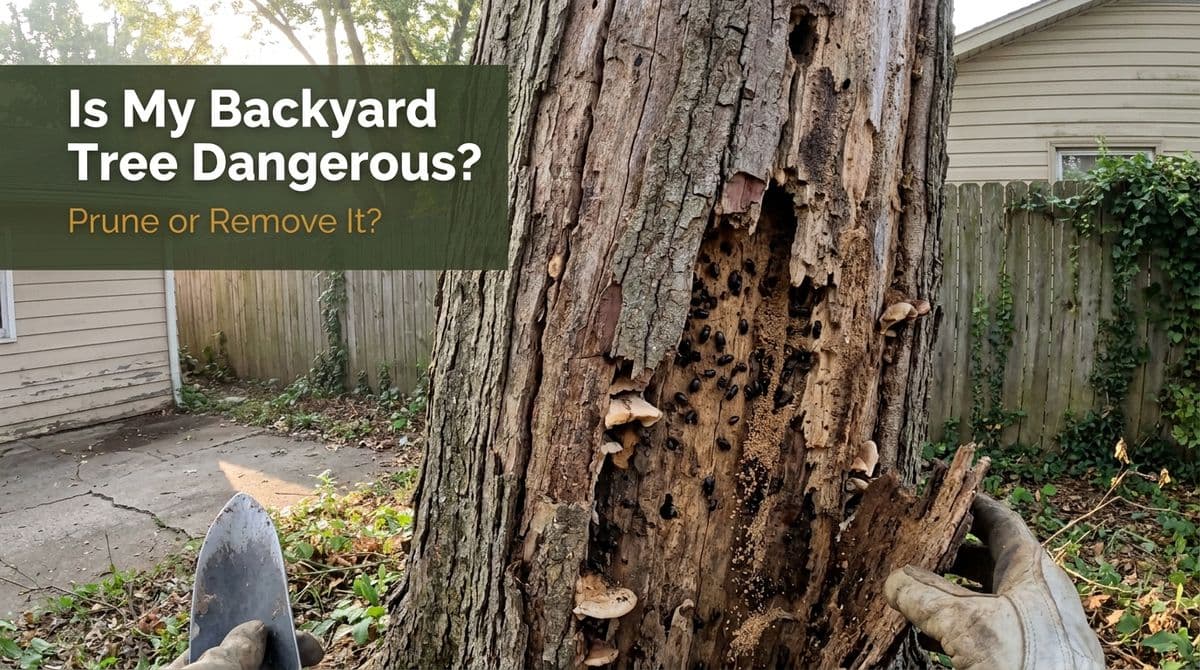
One of the best clues Adam gave us over the phone was what he saw when he cut up that fallen limb: the wood inside looked unhealthy, and there were ants using it as a highway.
Here’s what we look for when deciding if decay is localized (can be managed with pruning) or more advanced (often means removal):
- Discolored or punky wood: Wood that feels soft, stringy, or spongy instead of solid and firm.
- Hollow sections: Cavities inside large branches or at the trunk base.
- Mushrooms or fungal growth at the base or along the trunk.
- Cracks or seams running vertically in the trunk or major limbs.
In Adam’s case, the ants most likely weren’t the main problem. They were just taking advantage of wood that was already compromised. That’s very common: insects move into dead or decaying areas, they don’t usually cause all the damage themselves.
When we see decay in a large structural limb on an older tree — especially near homes — that’s often a strong argument for removal rather than just pruning.
Insects, Beetles, and What “Green” Really Means
With elms specifically, we also think about pests like elm beetles. They tend to show up on the leaves and can be a sign the tree is stressed or in decline. In our area, we see them hatch on the undersides of leaves or along damaged sections of the tree.
A tree can still be leafy and green and yet structurally unsound. That’s exactly what Adam had been told by the first company: the canopy looked fine, but there were signs of age, water damage, and internal issues. When you combine that with a recent limb failure, it’s a big clue the tree is in the later stages of its life.
When we come out, we’re not just looking at color; we’re reading the whole story: age, species, insect activity, decay patterns, and how much sound wood is left doing the heavy lifting.
When Pruning Is Enough vs. When Removal Is Safer
We always try to save a tree when it’s safe and realistic to do so, but we’re also very honest about the limits of pruning.
Pruning may be enough when:
- The tree is otherwise healthy and has a solid trunk and root system.
- Decay is limited to a small area or a few non-structural limbs.
- We can reduce weight over the house or fence while keeping good structure.
- There’s no history of major limb failures.
Full removal is usually the safer call when:
- The tree has already dropped large limbs in normal wind events.
- There is extensive internal decay, water damage, or age-related decline.
- The tree is tall and directly over a house, fence, or future roof project.
- Pruning would leave a very weak or unbalanced structure that’s unlikely to recover.
In Adam’s situation, he also mentioned something we hear a lot: he needed to replace the roof soon and didn’t want to install a brand-new roof only to have a failing elm drop branches on it a year or two later. In cases like that, the tree usually needs to be addressed first.
Why How the Tree Is Removed Matters
Adam was very clear: he didn’t want “the cheapest guy,” he wanted the job done properly. That’s crucial with backyard removals.
His elm was in the backyard, not accessible with a big crane truck. That meant a full removal would require climbing, rigging, and carefully lowering pieces over fences and away from roofs, rather than just dropping the tree in one shot.
Here’s what we focus on for a safe removal in a tight backyard:
- Climbing and rigging instead of relying on heavy bucket trucks that can’t even reach the tree.
- Controlled lowering of limbs with ropes instead of free-falling branches.
- Protecting lawns, fences, and neighboring yards during cleanup and hauling.
- Bringing in compact equipment (like a mini skid steer through a 36" gate) to move brush safely and efficiently.
This is why it’s important to hire a licensed, insured tree service with proper training and gear. A backyard removal with decay and structures nearby is not a DIY project and not something you want an unqualified crew experimenting on over your home.
How to Decide What to Do With Your Tree
If you’re looking at a questionable tree and wondering if it’s dangerous, you can start with a simple checklist:
- Has it dropped big limbs in the last year or two?
- Is it close enough to hit your house, fence, garage, or neighbor’s property?
- Do you see soft, discolored, or hollow wood in broken branches?
- Are there mushrooms, cracks, or obvious decay at the base or along the trunk?
- Do you have big projects coming up (like a new roof) that the tree is hanging over?
If you’re saying yes to several of those, it’s time for a professional evaluation. When we come out, we’ll walk you through what we see, when pruning can buy more safe years, and when removal is the wiser long-term investment to protect your home.
Whether your tree just needs a thoughtful pruning or it’s time for a full removal, the goal is the same: keep your property safe while making decisions that actually fit your budget and your plans for your home.